
Revised October 29, 2025 on the 63st birthday of a great mom of 11, Donna Marie Beckman
Patrick & Cyrus (apologist w/ Relevant R): hope this helps better understand the beauty of you having your older brother’s name, Thaddeus as part of the Bishop of Ireland’s;
My beloved Fr Rocky, Fr Kubicki, John Morales, Drew, Cale, Cyrus the Great Producer, Fr Simon, the Taco King Patrick THADDEUS Madrid, Cyrus and Catholic adventurers at Relevant Radio…including our Premonstratensians including Fr Holy Joe Horn, beloved Abbot Hayes (Yes, Abbot, still praying specifically per your request) Padre Augustine, Fr Edmund, Fr Louis, my son in law’s brother, et al.
This avid Relevant Rad listener wants to posit something else, beyond the Catholic icon Giza Pyramid (you know the ‘border fire in the middle” pile of multi-ton blocks) at the center of the world. Hmm Just lost the Taco King and maybe Fr Francis but Gamer of Drones Horn might still be in on the world’s largest object at the world’s exact center being a potential Catholic icon. But on to Jude!
======================onward to another look at Jude and the Shroud=========================
In all humility, please consider an alternative regarding Danny Thomas’ fave saint and our St Jude Thaddeus and the Golden Medallion.. the HOPEful patron saint of HOPEless and impossible causes. Fr Kubicki does excellent research but suppose:
My thoughts: St Jude Thaddeus was the Shroud’s first Courier of healing following Jesus’ resurrection.
- Of the apostles, St Jude, like the others, gained his “motto” or patronage by God or by practice. St Therese is known for her roses; Dominic the rosary…Joseph his carpenter tools.
The more famous “proof” of Jude’s patronage of hopeless and impossible causes would be Edessa’s King Abgar V’s cross-country hope for a cure. And IF Jude carried the miracle cloth, true relic of Jesus’ Resurrection, surely it would be useful for cures throughout his travels with the reformed Zealot, Simon; St Jude is known for his missionary work in part to Mesopotamia, Syria and Persia. Not to mention, as a healer and Exorcist: he could exorcise pagan idols, which caused the demons to flee and the statues to crumble. From Laudate app, Saint Jude is known as Jude of James, Judas Thaddaeus, Lebbaeus; Jude, brother of Jesus and Lebai Sleeha. In the Easter Church, there’s an additional memorial on June 19…interestingly, the date of Juneteenth in America. His profile contends he is the Son of the martyr, St. Cleophas and Mary, a Mary who stood at the foot of the Cross, and known to have anointed Jesus’ body after death… also, the brother of St James the Lesser, and nephew of Mary and Jesus’ foster father, Joseph of Nazareth. He was “reported to look a lot like Jesus”. My guess along the lines of Mary’s genes, maybe? - His patronage is listed as desperate situations, forgotten, lost or impossible causes. Also, hospital workers and hospitals, which speaks to why a popular TV star in the 60s looked to Jude for his love.
- The popular Danny Thomas St Jude hospital imagery in holy cards, mailings etc. (recall, the actor promised a shrine to St Jude if he was successful) points often to St Jude sporting a gold medallion, which I believe is a mistranslation/misuse of Mandylion or Acheiropoeiton (Εἰκόν’ ἀχειροποίητη) …
- Think back to 34AD, when historically, the early Church’s treasury was depleted somewhat by Judas thievery then recycling 30 silver pieces with the Jewish leaders: ie the Church was broke, did not have an Autom religious goods store yet; and would not have excess funds to strike a gold medal with Jesus’ image at that time. Just suppose, the Shroud could be the real object around his neck, for ease of travel, mounted in a cloth or wooden phylactery/frame. Folded four ways or more. Possibly one foot x one foot exposing the Face of Christ in the carrier.
- Jude could have been the Shroud bearer; there were no parish Catholic churches nearby to leave it and the Turin discovery was 15 centuries into the future; it traveled via Jerusalem, Edessa (Jude had been there and it was found in early 4th century as you will read later), Lirey, France etc. His gift of healing and provenance of the Gold Medal would be a live giveaway.
- It was safer chartered to one of the apostles. Just as the Holy Grail is reported to be in Valencia, Spain, Giza and the Christ Angle reported near Cairo, Egypt (see Isaiah 19:19-20) and other relics resident throughout the world. Like the one Fr Alan had us kiss on St Jude’s feast day in the Assumption church in the abbey dedicated to St Michael the ARCHangel.
From Wiki and other sources:
The leprous king who asked for Jesus to come heal is pronounced and spelled “Abgar” not Abigar as some pronounce it.
‘Abgar V is said to be one of the first Christian kings in history, having been converted to the faith by Thaddeus of Edessa, one of the 70 disciples According to Christian tradition, the Image of Edessa was a holy relic consisting of a square or rectangle of cloth upon which a miraculous image of the face of Jesus had been imprinted—the first icon (“image”). The image is also known as the Mandylion (from Greek μανδύλιον “cloth, towel”),[1] in Eastern Orthodoxy, it is also known as Acheiropoeiton (Εἰκόν’ ἀχειροποίητη), or “icon not made by hand”.
(Len’s comment: sorting real tradition from conjecture is not always easy. But, this Eastern painting of Abgar looking at a wide rectangular cloth and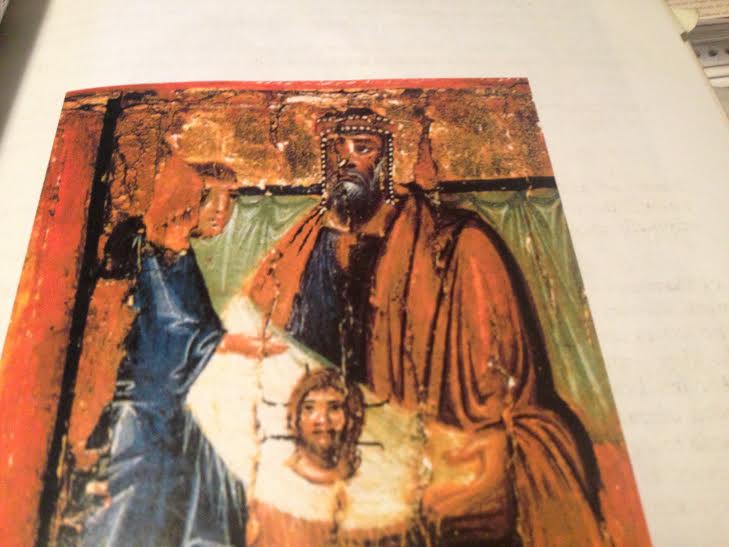 Jesus’ face in the middle should be considered. Yes, the Shroud physically had Jesus’ head, front and back in the middle of the 14′ cloth since it was wrapped vertically over his front and back side)
In the tradition recorded in the early 4th century by Eusebius of Caesarea, King Abgar of Edessa wrote to Jesus, asking him to come cure him of an illness. Conjecture is, Abgar received a reply letter from Jesus (I wasn’t aware Jesus had a traveling scribe with him like Nancy Pelosi’s videographer daughter, declining the invitation, but promising a future visit by one of his disciples.) OR possibly, St Jude went to Edessa, Turkey as a missionary of “lost and impossible causes”, to heal the inquisitive king. Further research needed.
One of the(apostles) seventy disciples, Thaddeus of Edessa, is said to have come to Edessa, bearing the words of Jesus, by the virtues of which the king was miraculously healed. (Len’s note: the Addai artist would be inconsequential if Jude BROUGHT the true 1st class relic of a Risen Savior.)
“Eusebius said that he had transcribed and translated the actual letter in the Syriac chancery documents of the king of Edessa, but who makes no mention of an image. The report of an image, which accrued to the legendarium of Abgar, first appears in the Syriac work, the Doctrine of Addai: according to it, the messenger, here called Ananias, was also a painter, and he painted the portrait, which was brought back to Edessa and conserved in the royal palace.”
The first record of the existence of a physical image in the ancient city of Edessa (now Urfa) was by Evagrius Scholasticus, writing about 593, who reports a portrait of Christ of divine origin (θεότευκτος), which effected the miraculous aid in the defense of Edessa against the Persians in 544. The image was moved to Constantinople in the 10th century. The cloth disappeared when Constantinople was sacked in 1204 during the Fourth Crusade, and is believed by some to have reappeared as a relic in King Louis IX of France‘s Sainte-Chapelle in Paris. This relic disappeared in the French Revolution.
The provenance of the Edessa letter between the 1st century and its location in his own time are not reported by Eusebius. The materials, according to the scholar Robert Eisenman, “are very widespread in the Syriac sources with so many multiple developments and divergences that it is hard to believe they could all be based on Eusebius’ poor efforts” (Eisenman 1997:862).
The Eastern Orthodox Church observes a feast for this icon on August 16, which commemorates its translation from Edessa to Constantinople.
My Sindonologist friends, Steve & Nancy Bottieri, self published a book on the Shroud called Agnus Dei (I gotta find my copy, what with loaning it out and with 11 kids not everything has its place).
Steve is a Jewish man converted to Catholicism; he posits (like Ian below and others) that the actual image discussed above was the actual Shroud. Not some sweaty Veronicaesque holy face diaper…
Its travels included France and Italy/Turin but note its being found (the missing Shroud in the Edessa city walls) in the fourth century
I see THREE 4 possibles: the wiped face of Jesus by the dispatched artist or two, his painting. Veronica’s cloth Sudarium for #3 OR what I believe makes more CSI forensic sense, the actual Shroud. Why would St Jude Thaddeus have special healing powers? A first class relic of Jesus, blood stained, and 40 gigajoules of energy that penetrated the cloth folded into a 12″ x 12″ square and carried in a frame of leather or wood. See Danny Thomas’ St Jude holy card above and well here>>>>>
If the King’s royal artist painted it, then it is NOT an image not made by human hands. So, this wouldn’t be the relic. (the Shroud is a 1st, 2nd and 3rd class relic, so to speak). If the artist had given Jesus a cloth and His sweat remained on the cloth, like the True Image Veronica, and was taken by the artist back for the leprosy miracle, then again, does this survive research? and credulity?
However, something major occurred to cause Jude Thaddeus to be considered the patron of miracles and impossible causes: to King Abgar, leprosy was impossible to get rid of (no sulfa drugs yet). And he had heard of the miracle worker Jesus
Suppose Jude was chartered to CARRY the Shroud as protection; there was no Catholic parish church in Jerusalem soon after Jesus departed. And the 14 x 3 foot Shroud could be folded up so a 1 foot square portion showing just His face was exposed.
“The later legend of the image recounts that because the successors of Abgar reverted to paganism, the bishop placed the miraculous image inside a wall, and setting a burning lamp before the image, he sealed them up behind a tile; that the image was later found again, after a vision, on the very night of the Persian invasion, and that not only had it miraculously reproduced itself on the tile, but the same lamp was still burning before it; further, that the bishop of Edessa used a fire into which oil flowing from the image was poured to destroy the Persians.”
The image itself is said to have resurfaced in 525, during a flood of the Daisan, a tributary stream of the Euphrates that passed by Edessa. This flood is mentioned in the writings of the court historian Procopius of Caesarea. In the course of the reconstruction work, a cloth bearing the facial features of a man was discovered hidden in the wall above one of the gates of Edessa. (Review how representations of Jesus changed in art once the Shroud was REDISCOVERED)
Writing soon after the Persian siege of 544, Procopius says that the text of Jesus’ letter, by then including a promise that “no enemy would ever enter the city”, was inscribed over the city gate, but does not mention an image. Procopius is skeptical about the authenticity of the promise, but says that the wish to disprove it was part of the Persian king Khosrau I‘s motivation for the attack, as “it kept irritating his mind”.[8] The Syriac Chronicle of Edessa written in 540-550 also claims divine interventions in the siege, but does not mention the Image.[9]
Some fifty years later, Evagrius Scholasticus in his Ecclesiastical History (593) is the first to mention a role for the image in the relief of the siege,[10] attributing it to a “God-made image”, a miraculous imprint of the face of Jesus upon a cloth.
The Shroud certainly wasn’t in Jerusalem or Turin at that time. Could it be Jude was its messenger and courier?
“Thus we can trace the development of the legend from a letter, but no image in Eusebius, to an image painted by a court painter in Addai, which becomes a miracle caused by a miraculously-created image supernaturally made when Jesus pressed a cloth to his wet face in Evagrius. It was this last and latest stage of the legend that became accepted in Eastern Orthodoxy, the image of Edessa that was “created by God, and not produced by the hands of man”. This idea of an icon that was Acheiropoietos (Αχειροποίητος, literally “not-made-by-hand”) is a separate enrichment of the original legend: similar legends of supernatural origins have accrued to other Orthodox icons.”
The Ancha icon is reputed to be the Keramidion, another acheiropoietos recorded from an early period, miraculously imprinted with the face of Christ by contact with the Mandylion. To art historians it is a Georgian icon of the 6th-7th century.
According to the Golden Legend, which is a collection of hagiographies compiled by Jacobus de Voragine in the thirteenth century, the king Abgarus (Abgar one supposes) sent an epistle to Jesus, who answered him writing that he would send him one of his disciples (Thaddeus of Edessa) to heal him. The same work adds:
And when Abgarus saw that he might not see God presently, after that it is said in an ancient history, as John Damascene witnessed in his fourth book, he sent a painter unto Jesu Christ for to figure the image of our Lord, to the end that at least that he might see him by his image, whom he might not see in his visage. And when the painter came, because of the great splendour and light that shone in the visage of our Lord Jesu Christ, he could not behold it, ne could not counterfeit it by no figure. And when our Lord saw this thing he took from the painter a linen cloth and set it upon his visage, and emprinted the very phisiognomy of his visage therein, and sent it unto the king Abgarus which so much desired it. And in the same history is contained how this image was figured. It was well-eyed, well-browed, a long visage or cheer, and inclined, which is a sign of maturity or ripe sadness.
Later events
The Holy Mandylion disappeared again after the Sassanians conquered Edessa in 609. A local legend, related to historian Andrew Palmer when he visited Urfa (Edessa) in 1999, relates that the towel or burial cloth (mendil) of Jesus was thrown into a well in what is today the city’s Great Mosque. The Christian tradition exemplified in Georgios Kedrenos‘ Historiarum compendium[13] is at variance with this, John Scylitzes[14] recounting how in 944, when the city was besieged by John Kourkouas, it was exchanged for a group of Muslim prisoners. At that time the Image of Edessa was taken to Constantinople where it was received amidst great celebration by emperor Romanos I Lekapenos, who deposited it in the Theotokos of the Pharos chapel in the Great Palace of Constantinople. Not inconsequentially, the earliest known Byzantine icon of the Mandylion or Holy Face, preserved at Saint Catherine’s Monastery in Egypt, is dated c. 945.[15]
“The Mandylion remained under Imperial protection until the Crusaders sacked the city in 1204 and carried off many of its treasures to Western Europe, though the “Image of Edessa” is not mentioned in this context in any contemporary document. Similarly, it has been claimed that the Shroud of Turin disappeared from Constantinople in 1204, when Crusaders looted the city. The leaders of the Crusader army in this instance were French and Italian (from Venice), and it is believed that somehow because of this, the Shroud made its way to France. A small part of a relic, believed to be the same as this, was one of the large group sold by Baldwin II of Constantinople to Louis IX of France in 1241 and housed in the Sainte-Chapelle in Paris (not to be confused with the Sainte Chapelle at Chambéry, home for a time of the Shroud of Turin) until it disappeared during the French Revolution.
The Portuguese Jesuit, Jerónimo Lobo, who visited Rome in 1637, mentions the sacred portrait sent to King Abgar as being in this city: “I saw the famous relics that are preserved in that city as in a sanctuary, a large part of the holy cross, pieces of the crown and several thorns, the sponge, the lance, Saint Thomas’s finger, one of the thirty coins for which the Saviour was sold, the sacred portrait, the one that Christ Our Lord sent to King Abagaro, the sacred staircase on which Christ went up and down from the Praetorium, the head of the holy Baptist, the Column, the Altar on which Saint Peter said mass, and countless other relics.”
-
Author Ian Wilson has argued that the object venerated as the Mandylion from the 6th to the 13th centuries was in fact the Shroud of Turin, folded in four, and enclosed in an oblong frame so that only the face was visible.Wilson cites documents in the Vatican Library and the University of Leiden, Netherlands, which seem to suggest the presence of another image at Edessa. A 10th-century codex, Codex Vossianus Latinus Q 69 found by Gino Zaninotto in the Vatican Library contains an 8th-century account saying that an imprint of Christ’s whole body was left on a canvas kept in a church in Edessa: it quotes a man called Smera in Constantinople: “King Abgar received a cloth on which one can see not only a face but the whole body” (in Latin: [non tantum] faciei figuram sed totius corporis figuram cernere poteris).
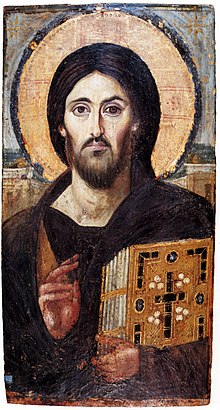
Christ Pantocrator
https://en.wikipedia.org/wiki/Abgar_V also refer to the image of Edessa
(Len: fellow adventurers: we know that Christian art began to reflect the dark bruise under Jesus’ left eye, obviously not mascara but from His Holy Scourging, moving away from a more sterile imagery, AFTER the Shroud was rediscovered in the early centuries.
For example, in Christ Pantocrator, the two eyes are different and the left reflects the heavy bruising under His left eye.
I believe real time and history needs to be a part of our understandings of Church history; being extremely careful not to go heretical like Algore and the climate cultists who insult God, claiming man’s ability to change climate with 12 manmade CO2 molecules for every million air molecules ( a subject for a different blog 12:1,000,000 or 1:2500 showing God’s perfect atmospheric science). Someday I hope my Church and Pope Francis come to the truthful understanding of this lie about the miracle gas carbon dioxide; its use as an excuse to banish natural gas, the most energy efficient lowest polluting gas useful to help 3rd worlders raise their standards of living; not to mention oil, required for 6000 products. Just a little wisdom proves that the Marxist anti-production elements love demonizing one of God’s greatest gifts He uses to FEED His World via photosynthesis and aerobic respiration. A topic for another time, maybe never, sadly.
Think about the last three humans seeing Jesus is His fullest no wounds glory: Peter, James and John at the Transfiguration.
I believe Peter, James and John were the last to see Him the way they did, because in heaven, Jesus will forever have the DThomas’ left eye, scourging marks, nails and spear wounds. Yes, even His mother will see the evidence of the greatest gift to mankind by the greatest Being: God’s son. Our sense of beauty isn’t necessarily heaven’s or God’s.
His bruises reflect our grateful eternal gift of hope and life. Even the dead Moses and alive Elijah had the same view.
I may be wrong, as a dad of 11 in 41st year of homeschooling the Catholic way can be, but Jude, the Shroud bearer, traveling the world before his death and now still patronizing the prayers of humans on earth for healings, makes sense.
Just like the female caller mentioned about a cancer cure spoken on one of John Morales’ morning air show due to a novena to Jude Thaddeus.
In case you don’t know this, St Jude was clubbed to death (one of his presentations like the Gold Mandylion [Jesus is MORE precious than gold] and then the odd: he was beheaded in the country he preached previously, Persia. God is the God of Godincidences. Previously: “Persian king Khosrau I‘s motivation for the attack, as “it kept irritating his mind”. As you read this, another Persian king whom I call the supreme IraNazi Persian King Khoumenei, reigns in the modern Persia, Iran today and as a non-Arab Muslim, supports and puppets Hamas (and Hezbollah, the Islamic Jihadist and other enemies of Israel and the United States.) Historically, 2500 years ago the annihilation of the Jews was prevented by another Persian king Artaxerxes or Ahasueras when the Jewess Queen Esther pled for her people and Hanan the Hittite’s total kill off of the Jews was prevented. Not so with today’s Persian king Kho etc. Pray for justice and peace for the Jews and Palestinians, many of whom are Catholic.

Fr Louis Hager, newer priest at St Michael’s Abbey
God bless the mighty relevant radio and tacos away to the Patrick Madrid Experience… RelRadio is an amazing blessing to so many.
To the Abbey and its Premonstratensians (a mouthful!) who each have good and specific talents to share and preach the Gospel (40-60 churches in OC and LA Diocese benefit each weekend from these Godly men) as they answer the call of Christ: to be “fishers of men.”
Thank you to Donna for her 49 days short of 49 years on earth serving God, the Church and bearing 11 great kids. And the namesaked stepmom, Mary, who so determinedly seeks God’s favor and the heaven that await those that follow Christ.
In His Service,
Len Beckman
 lifeoutloudest